
Tutorials
English · Guide
How to Write Better AI Video Scripts with PostPlus
A practical workflow for using PostPlus and an AI agent to learn from reference videos, extract reusable structure, and turn product context into a short-form video script.
English · Guide
A practical workflow for using PostPlus and an AI agent to learn from reference videos, extract reusable structure, and turn product context into a short-form video script.
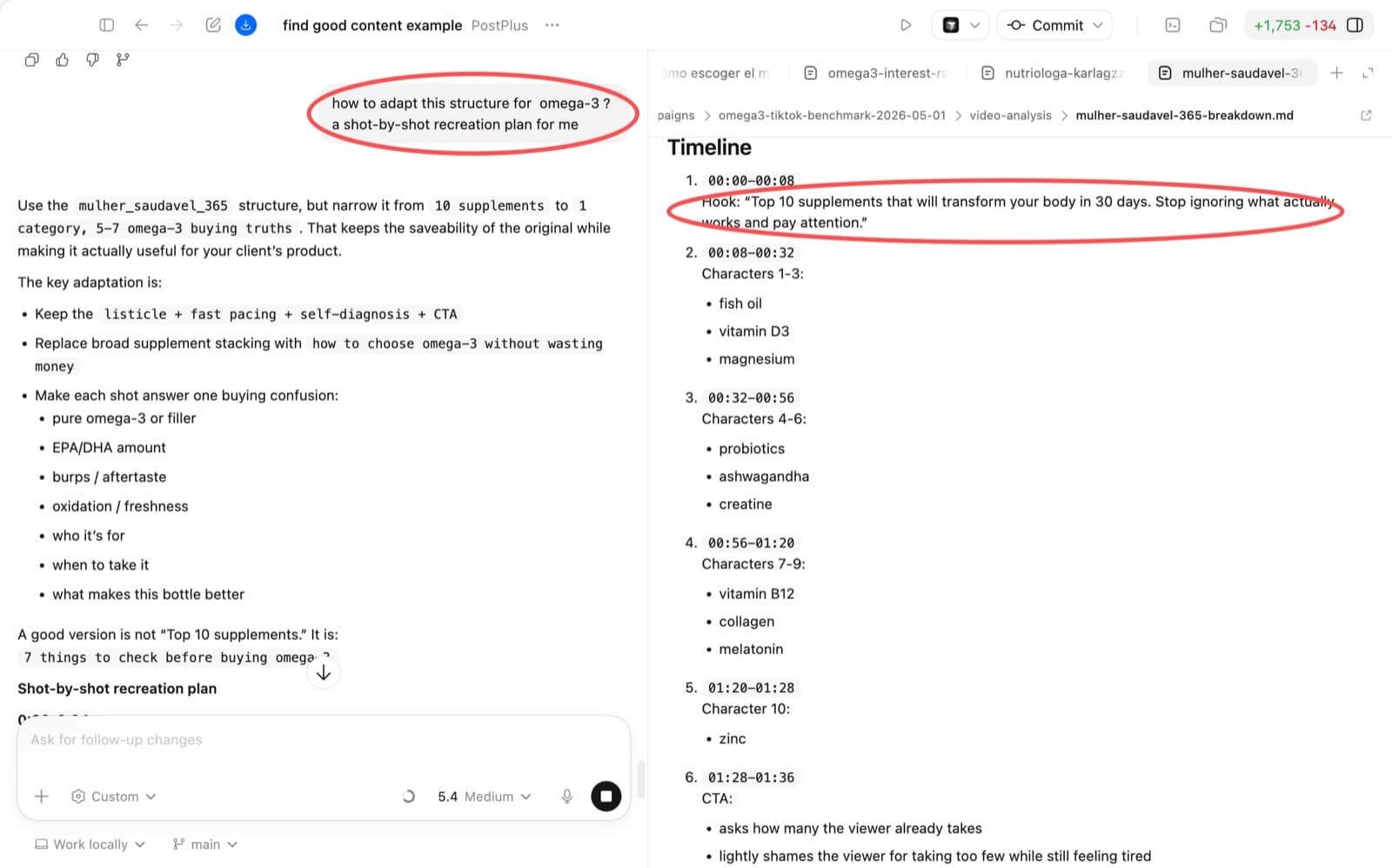
Writing better AI video scripts means giving the agent three inputs: product context, proven reference structure, and production constraints. The goal is not to ask AI for a generic ad. The goal is to make AI learn why a strong short-form video works, then adapt that structure to a new product without copying the original.
PostPlus is a short-form marketing workflow for local AI agents. It helps teams research reference videos, deconstruct scripts and visuals, then convert those patterns into scripts, asset plans, and production briefs.
An AI video script should translate a proven reference structure into a new, product-specific beat plan. In the PostPlus workflow, scriptwriting comes after reference-video teardown and before AI asset generation, so every voiceover line maps to a visual requirement.
AI video quality depends heavily on the script before any image or video model is involved. A weak script produces weak assets because the production system does not know what each beat must communicate.
Use the script to define:
| Script Layer | What It Controls | Why It Matters |
|---|---|---|
| Audience | Who the first line is speaking to. | The hook needs a specific viewer. |
| Promise | What problem, desire, or transformation is introduced. | The viewer needs a reason to keep watching. |
| Beat sequence | What happens in each segment. | Asset generation needs clear scene boundaries. |
| Proof | What the viewer sees or hears that makes the claim believable. | Generic claims do not create trust. |
| CTA | What action the viewer should take next. | The ending must resolve into a decision. |
Before asking for a script, ask the agent to understand the product and suggest research directions.
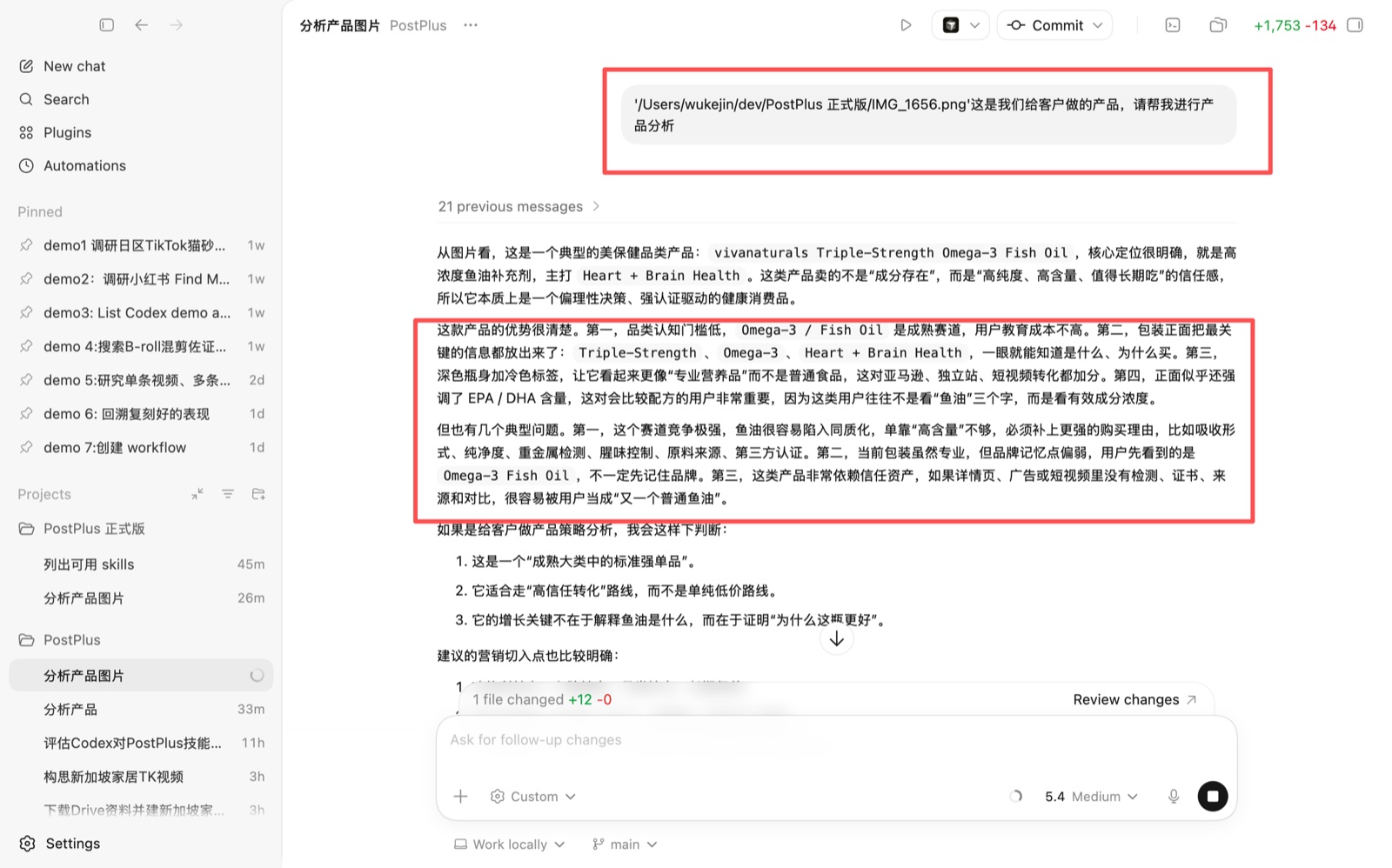
[put your product details or local path here]
This is the product we made for our client.
Please help me analyze it, and tell me what we can search on TikTok to find relevant videos.
This first step prevents the agent from writing from a blank page. It also creates a bridge between product claims and social-video search intent.
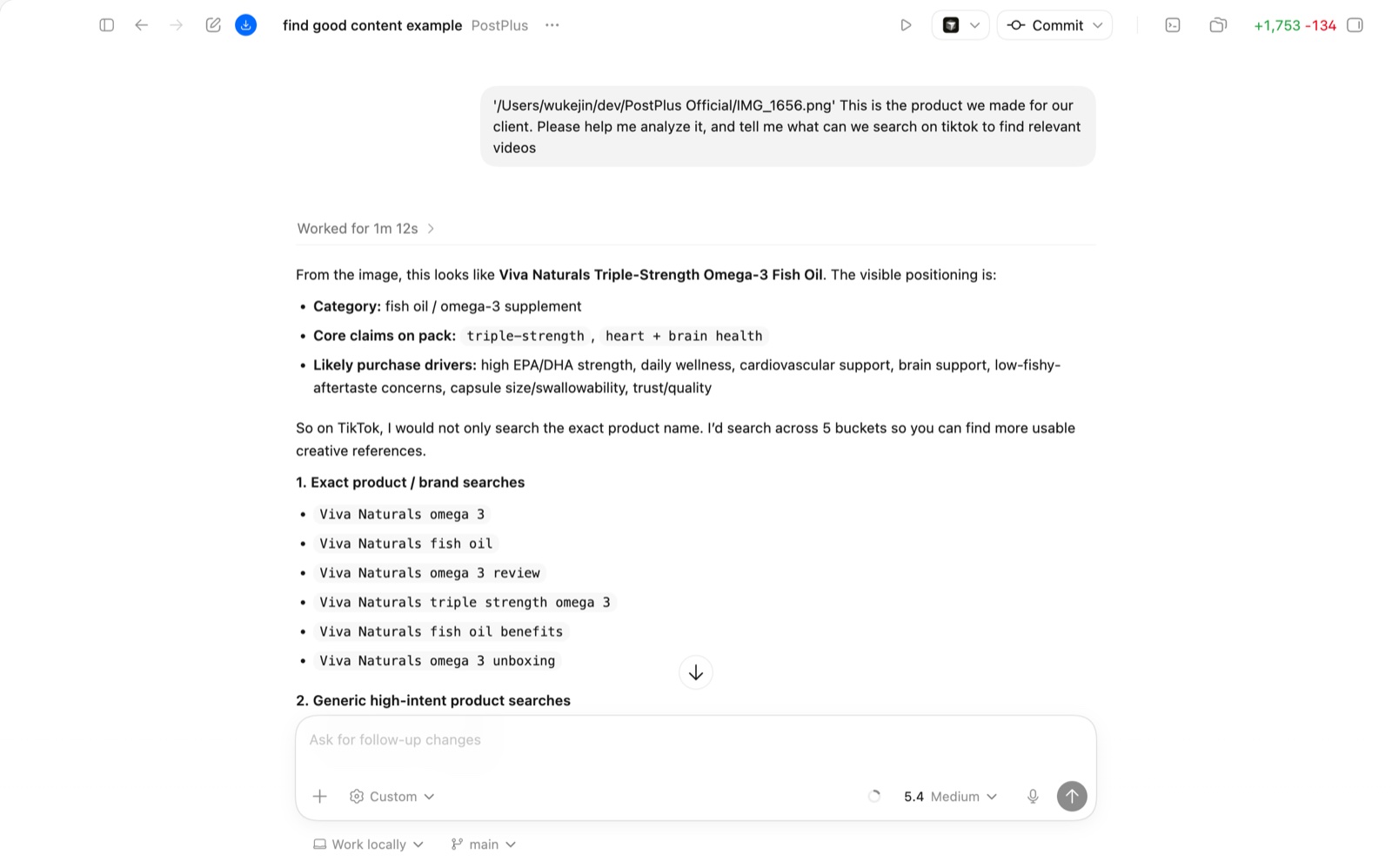
Do not accept the first AI-generated angle as the final script. Use PostPlus to find and deconstruct actual videos first.
The research sequence is:
The important rule is separation: learn the structure, not the surface execution. A winning reference might use a sports hook, an animated nutrient character, or a simple product demo. The new script should keep the strategic logic while changing the product, examples, visuals, and CTA.
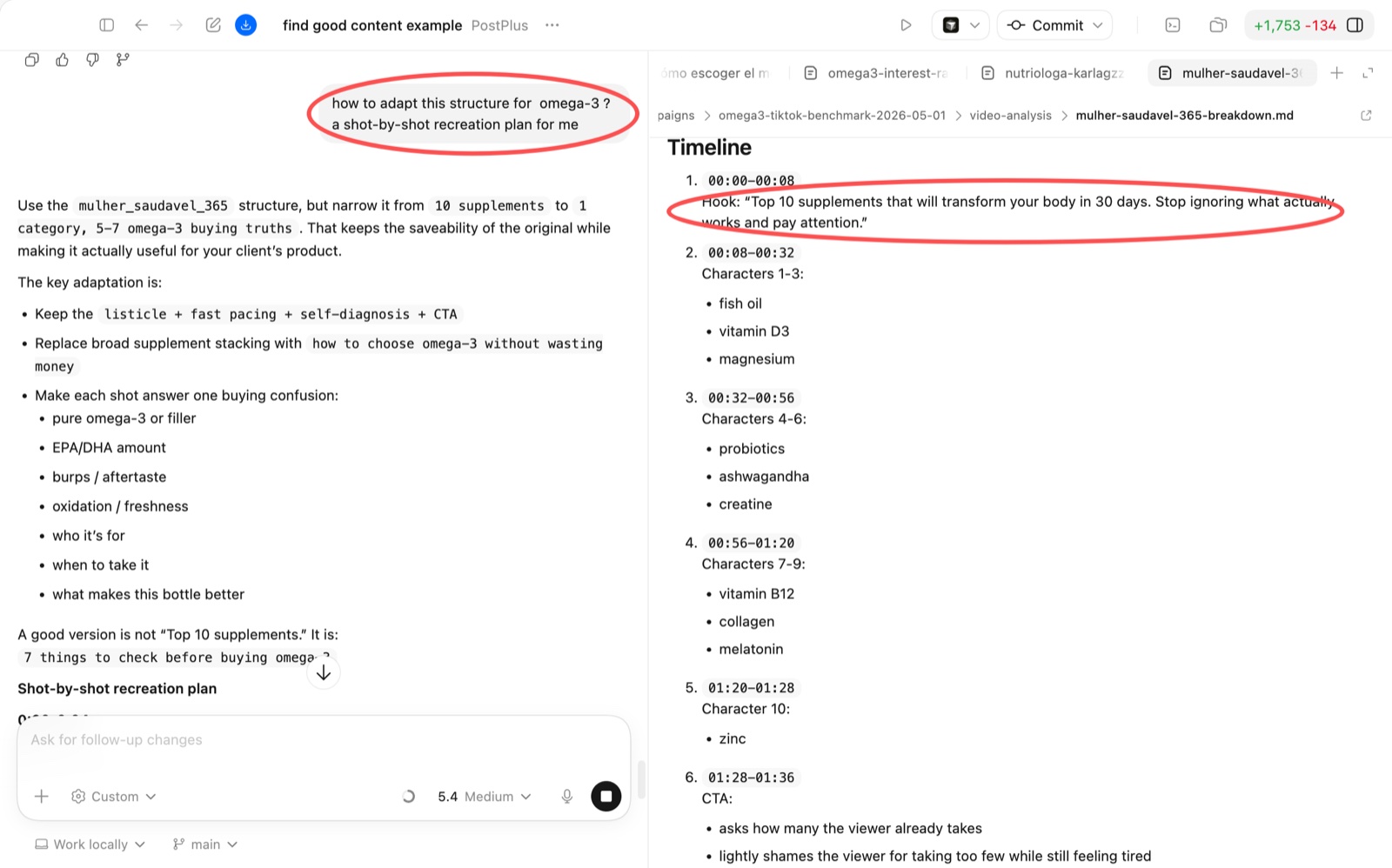
Once the agent understands both the product and the reference structure, ask for a production-ready script.
Based on the reference video, break down how many materials we need for this video and how long each one should be.
Give me a script and shooting plan.

I want to use the animation structure from the reference:
- each recovery nutrient appears together at the start,
- each one gets its own short introduction,
- the fish oil character appears near the end,
- the final beat transitions into the CTA.
This prompt is useful because it asks for both copy and production logic. The output should tell you what to say, what to show, and how long each part should last.
Do not treat the AI draft as final. Spend a few rounds checking whether the script is clear enough to produce.
Review these questions:
Most useful scripts improve after 1-4 revision rounds. The point is not to polish every sentence. The point is to remove ambiguity before asset generation begins.
Use this checklist before moving into image or video generation.
| Check | Pass Signal |
|---|---|
| Hook | The first line creates recognition, curiosity, or tension. |
| Structure | The video has clear beat boundaries. |
| Visual plan | Every line has an obvious image or scene. |
| Adaptation | The script borrows reference logic without copying the reference. |
| Production readiness | The team can count required assets from the script. |
If the script fails this checklist, generating assets will only make the problem more expensive.
It can write a draft, but reference-based scripts are usually more useful. References show timing, hook style, proof sequence, and visual logic that a blank prompt often misses.
No. Use the reference to understand structure, pacing, and proof. Copying the words, scenes, or character execution makes the output less original and harder to defend.
Usually 1-4 rounds are enough for a short-form production draft. Stop when the script clearly defines the audience, promise, beat sequence, visual plan, and CTA.
Turn the script into an asset list: reference frames, generated images, generated clips, voiceover, captions, and editing instructions.